
October 24, 2025 | Breast Surgery
7 minute read
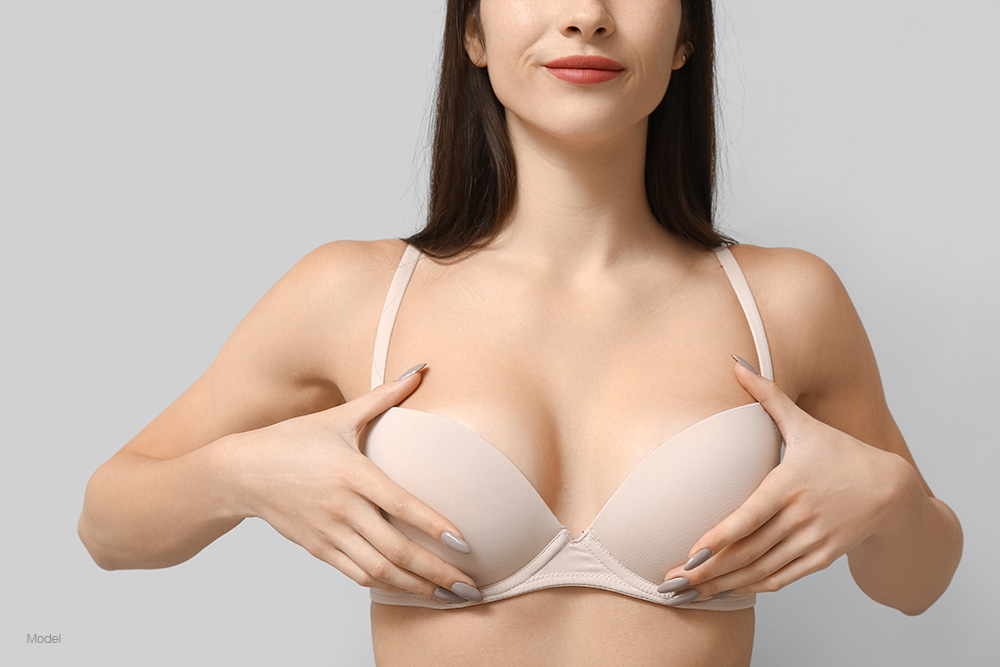
If you’re considering breast augmentation, you may be dreaming in cup sizes. Perhaps you want to go from A cup to D cup breast implants. What about C cup breast implants? This complete guide will help you understand everything you need to know about breast implant sizes, including dimensions like volume, diameter, and profile, as well as how breast implant size translates to bra cup size.
Breast Implant Options
Breast augmentation is one of the most customizable plastic surgery procedures performed today. Not only are there options in terms of incision placement (which is where your scars will be located), breast implant placement (below or above the pectoral muscle or subfascial), and implant material (silicone or saline), but the implants themselves have several dimensions you can customize to your liking, sculpting your ideal aesthetic in 3D.
These dimensions are: implant volume, diameter, and profile. Altering each one will affect how your breasts look overall, including size, shape, and symmetry. No two breast augmentation results are the same, and implant dimensions are a major reason why.
Implant Volume
We tend to think of natural breast volume, or size, in terms of bra cup size. Each bra company varies in what they determine to be “cup” size for their line of lingerie. However, breast implant volume is measured in terms of cubic centimeters (cc) and not really in cup size. So, a surgeon cannot guarantee a specific cup size, but rather thinks about adding your natural breast volume plus your implant volume.
In the United States, breast implant volume can range from the smallest implant, at 80cc, to the largest, measuring 800cc. A popular implant volume range for most patients is 300cc to 400cc, but the best implant volume depends on the patient’s goals and their unique anatomy.
Generally speaking, a small breast implant is about 150 to 200cc in volume. A mid-range implant volume is 300 to 350 cc, and a large breast implant is anything over 400cc.
Implant Diameter
The diameter of your implant refers to the width of its base—usually ranging from 7.4 to 17.2 centimeters. Implant diameter is responsible for the shape of the breast outline. The best fit for you will depend on your chest size and your desired aesthetic. Your ideal implant diameter tends to closely match the base width of your natural breasts.
Cleavage is created with your natural breast tissue over the top of your stable implant and isn’t heavily influenced by the implant diameter. So, if you are thin and have little breast tissue prior to surgery, then you are unlikely to have kissing cleavage after surgery. Patients with a wide base of breast can support a wider diameter, while those with a narrow base of breast benefit the most from a more narrow diameter.
Implant Profile
Breast implant profile refers to how far the breast implant will project from your chest wall. If you stand sideways in front of a mirror, you can visualize how far a breast implant might push your breast forward.
Implant profile ranges from low to ultra-high, depending on your desired outcome. Two implants with the same cubic centimeters of volume can make the breasts look bigger or smaller solely based on the implant profile.
- High-profile, very high-profile, or ultra high-profile implants provide the most forward projection. This creates a rounder, more uplifted appearance, increased fullness in the upper breast pole, and the most defined cleavage. They are also a great option for patients with narrower chests.
- Low-profile implants project the least and have a wider base. These are the least common, but an excellent option for patients who have wider chests or who want a softer, more natural-looking result.
- Moderate profile implants strike a balance between width and projection, and are popular for their ability to provide noticeable yet still natural-looking results.
Endless Customization
As implant volume increases, generally speaking, so does projection. As implant diameter increases or widens, the implant projection decreases. And even if two patients get the exact same implants with the same material, volume, width, and projection, the result will be different based on their starting anatomy—including chest size, natural breast tissue, and other factors.
If you feel overwhelmed by these dimensions, or if you’re simply curious to see how different implants would look on you, we invite you to schedule a consultation at Burgess Plastic Surgery. Dr. Elisa Burgess is a board-certified plastic surgeon who specializes in cosmetic and reconstructive breast enhancement surgeries. At her practice, she uses advanced 3D imaging technologies, like TouchMD and Crisalix, to help you visualize how your breasts will look with different implants, sizes, projections, and more.
TouchMD allows you to access diagrams and educational materials after hours—from the comfort of your home—so you can feel informed and empowered about your treatment options. Meanwhile, Crisalix’s 3D goggles allow you to look down at your chest and “see” what your breasts might look like a few months after surgery. Sounds fun? Come meet with us and let’s discuss your options!
Bra Cup Size to Breast Implant Size
This section might be exactly what you came for. The primary motivation for most patients seeking breast augmentation is an increase in breast size or cup size. Patients want to know: how many cc is a D cup? What are A cup implants? What is a C cup boob job?
The truth is, cup size is not a reliable unit of measurement because it ultimately varies by brand. Also, cup size is dependent on the difference in inches between A) the circumference of your chest, and B) the fullest part of your bust. Two women may be the same cup size and have completely different-looking breasts, and you may have different cup and band sizes across brands.
Still, since this is the measurement most of us are familiar with, this quick guide might help you grasp the range of implant volume you’re looking for. As a rule of thumb, every 150 to 200cc will translate as roughly one cup size increase.
- A cup to B cup: 150 to 200cc implant volume
- A cup to C cup: 300 to 350cc
- A cup to D cup: 370 to 450 cc
- B cup to C cup: 250 to 350cc
- B cup to D cup: 350 to 400cc
These conversions are not exact math, however, as your final cup size will depend on your chosen implants, plus your starting chest size and natural breast tissue.
If you have a specific cup size in mind, be sure to tell Dr. Burgess at your consultation. Bring photos or a description of the size and aesthetic you want for your breasts, and Dr. Burgess can help guide you in choosing the perfect implants for you—including brand, material, volume, diameter, and projection.
Learn More About Breast Implant Sizes in Portland and Lake Oswego, OR
Dr. Elisa Burgess is a board-certified plastic surgeon serving Portland and beyond. She and her friendly staff invite you to visit the office, have fun experimenting with our 3D imaging technology, and discuss your goals and options to find your perfect breast implants and treatment plan.
To schedule your personal consultation at Burgess Plastic Surgery, please call (503) 699-6464 or use our online contact form. We look forward to meeting you!